
Summer meeting · Residential
Summer Meeting 2017
- Dates
- 17–20 July 2017
- Venue
- King’s College London (Waterloo Campus, Franklin-Wilkins Building)
- Presidency
- Prof. Paul Joyce
Programme
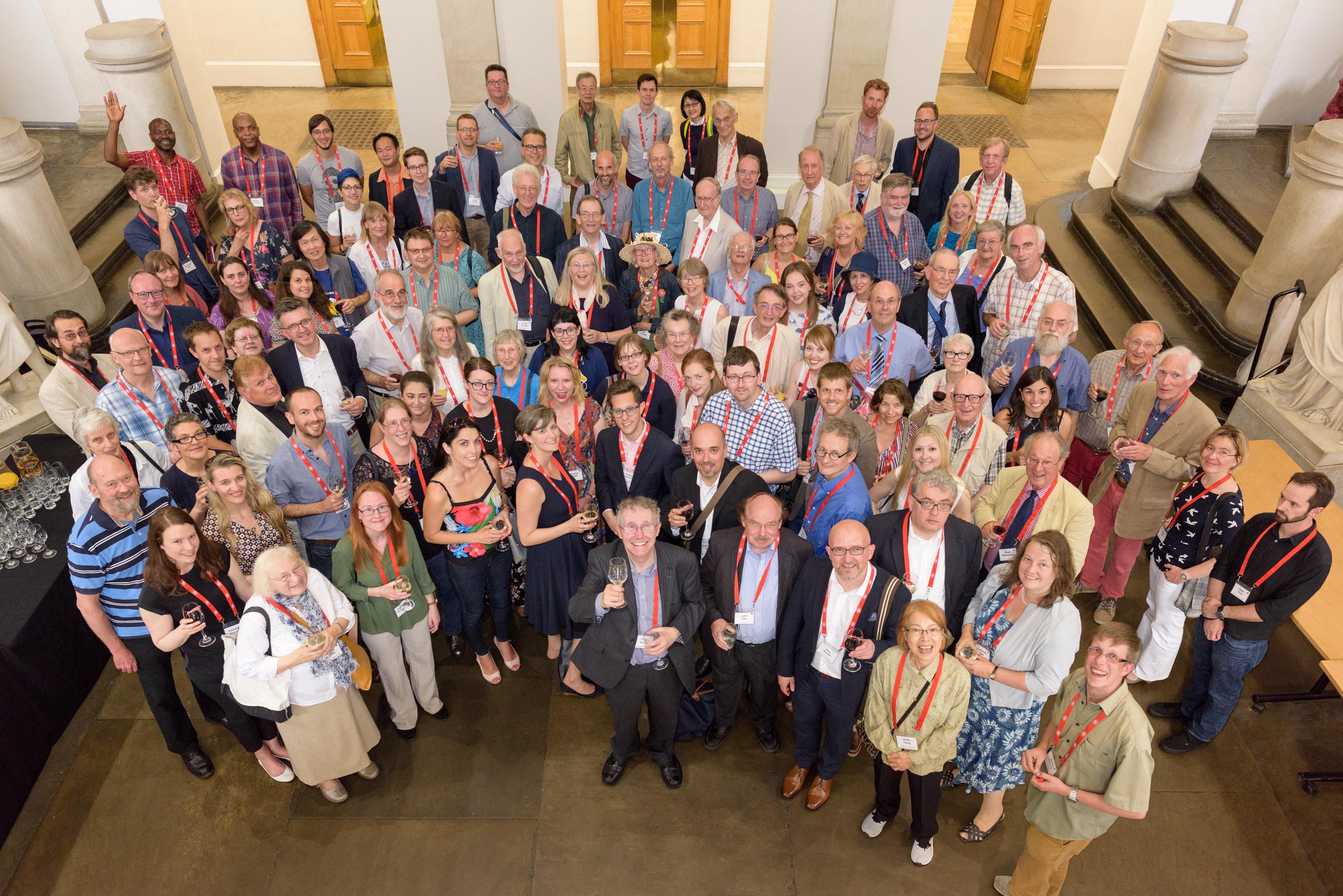
King’s College London (Waterloo Campus, Franklin-Wilkins Building)
confidential material (minutes of the previous business meeting as well as proposals for membership) can be found here (log-in required).
Franklin-Wilkins Building, Stamford St, SE1 9NH (see here for a pdf with travel information).
17—20 July 2017
Under the presidency of Prof. Paul Joyce
Printable version of the Programme.
Booking form for the Summer Meeting (pdf)
Publishers are invited to display books for sale during the Meeting.
Members who have had books published recently are also invited to display copies.
MONDAY 17 July
- [2.00 pm Committee Meeting]
- 4.30 pm Registration (Franklin-Wilkins Building, Waterloo)
- 6.00 pm Reception, sponsored by the Department of Theology & Religious Studies, King’s College London (Strand: King’s Building)
- 6.45 pm Dinner (Strand: Great Hall)
- 8.15 pm Benjamin Sommer (New York), “The Priestly Literature as Proto-Kabbalah. Or, How Distinct Should Biblical Studies Be within Religious Studies?” (Strand: Safra Lecture Theatre)
TUESDAY 18 July
- 8.00 am Breakfast
- 9.15 am Casey Strine (Sheffield), “Sister Save Us: The Matriarchs as Breadwinners and Their Threat to Patriarchy in the Ancestral Narrative”
- 10.00 am David Clines (Sheffield), “Alleged Female Language about the Deity in the Hebrew Bible”
- 10.45 am Tea and Coffee
- 11.15 am Jan Joosten (Oxford), “Etiologies of Monotheism and their Significance in the Hebrew Bible”
- 12.00 noon Francesca Stavrakopoulou (Exeter), “The Troublesome Corpse”
- 13.00 pm Lunch
- 2.30 pm Frances Reynolds (Oxford), “Cuneiform Scholars in Hellenistic Babylon”
- 3.15 pm Jennifer Dines (Cambridge), “The Motif of Flight in Septuagint Amos”
- 4.00 pm Tea and Coffee
- 4.30 pm Martin Goodman (Oxford), “Bible Interpretation in the First Century CE: the Significance of Philo, De Migratione Abrahami 89-93”
- 6.00 pm Reception, sponsored by Bloomsbury Press
- 6.30 pm Dinner
- 8.15 pm “The David Fragments – After Bertolt Brecht” (David Shepherd and Nicholas Johnston, Dublin) (Guy’s Campus: Greenwood Theatre)
WEDNESDAY 19 July
- 8.00 am Breakfast
- 9.15 am Joan Taylor (London), Dennis Mizzi (Malta) and Marcello Fidanzio (Lugano), “Qumran Caves Dispersed Artefacts and Archives Project”
- 10.00 am Jessica Keady (Helsinki), “Masculinities and the Men of the Qumran Communities: Re-Evaluating the Ideals of Purification, Power and Performance in the Dead Sea Scrolls”
- 10.45 am Tea and Coffee
- 11.15 am Andrew Mein (Cambridge), “The Imprecatory Psalms at War”
- 12.00 noon Business Meeting (SOTS Members only)
- 1.00 pm Lunch
- 1.45 pm Outing to the National Gallery (Ben Quash and Jennifer Sliwka, London)
- 4.00 pm President’s Tea (National Gallery)
- 5.30 pm The Jordanian Lead Books – Panel discussion (James Aitken [Cambridge], Margaret Barker [Borrowash], Bernhard Lang [Paderborn], and Alan Millard [Liverpool])
- 6.15 pm Reception
- 6.45 pm dinner
- 8.15 pm John Barton (Oxford), “Some Thoughts on Biblical Translation”
THURSDAY 20 July
- 8.00 am Breakfast, followed by departure
Domestic Arrangements
The venue for the Meeting is the Franklin Wilkins Building, Stamford Street, London, SE1 9NH (accommodation opposite), and the contact telephone number is (+44) 02078 365454. Please refer to the enclosed maps for information on how to get to the Waterloo Campus. There are two public car parks relatively nearby, but otherwise only drop off and pick up behind the venue. Driving in London is typically fraught and the venue is within the Congestion Charge zone, so please use public transport if at all possible. The charges for hospitality are shown on the enclosed Booking Form. Members are requested to pay their accounts in full when returning the form but, if necessary, a non-returnable booking fee of £35 will be accepted and the balance will be payable on arrival at the Meeting.
There is a subsidized price for those on low incomes or from economically disadvantaged countries. Applications for a further conference grant to assist in meeting the costs of attending the Meeting must reach the Secretary, Dr David Shepherd (shepherd@tcd.ie) by 8th November. Application forms for grants are available on the SOTS website, /.
The charges for hospitality are shown on the Booking Form. There is an option of standard or en-suite rooms but NO twin or double rooms. Members are requested to pay their accounts in full when returning the form but, if necessary, a non-returnable booking fee of £35 will be accepted and the balance will be payable on arrival at the Meeting. A discounted price is available to those whose bookings are received by 2 May 2017 (please see the details on the form). There is a subsidised price for those on low incomes or from economically disadvantaged countries. All bookings must be received by Tuesday 13 June 2017; no bookings can be accepted after that date. Bookings can be made by email to sotshospitality@gmail.com with cheques to follow by post, or payment by bank transfer. Please note that in making a booking, members render themselves liable for payment of the full cost of that booking, a liability that will be waived only in the light of extenuating circumstances and only when the final conference accounts permit a refund. You may wish to consider taking out insurance on your booking (or check that your annual travel insurance is applicable) to cover the possibility of you having to cancel your booking. You are advised to make a copy of your completed Booking Form for your own records.
Abstracts
Benjamin Sommer (New York), “The Priestly Literature as Proto-Kabbalah. Or, How Distinct Should Biblical Studies Be within Religious Studies?” (Strand: Safra Lecture Theatre)
Noting that Moshe Idel has proposed that kabbalah is best defined as consisting of a set of ritual behaviors, especially theurgical ritual behavior and observing that kabbalah entails the ideas that explain and justify those rituals, this paper reviewed scholarship from the past several decades concerning the systems of ritual purity and sacrifice in the Pentateuch’s Priestly Document, as well as that document’s narrative of cosmogony and its relationship to the Tabernacle. In light of this scholarship (by scholars such as Jacob Milgrom, Baruch Schwartz, and Jonathan Klawans), it was suggested that the core of P’s ritual system is what Idel would call ‘drawing-down theurgy,’ while P’s narrative of a deliberately incomplete divine cosmogony (Genesis 1) and its long-delayed climax in human temple-building (Exodus 25-40) serve as the ideology justifying and explaining the ritual system. While the actual rituals prescribed by P and by medieval kabbalists are entirely different and without historical or genetic connection, their purposes are strikingly similar. From the point of view of the phenomenology of religion, P and classical kabbalah can be regarded as two manifestation of a single religious impulse. The difference between the legalism of E and D (which may be seen as proto-Maimonidean) and the entirely different conception of the law as a means to a theurgical end in P shows that core debates of Jewish thought are embedded in the earliest strata of Jewish literatures. Thus this paper encouraged greater dialogue among biblical critics, scholars of Jewish thought, and phenomenologists of religion. Further, it sought to identify essential themes of the P literature that have been overlooked, in particular its focus on God’s desire to dwell on earth among humanity. In light of this analysis, it becomes clear that the P document is at once proto-kabbalistic and the most Christian corpus within the Old Testament.
Casey Strine (Sheffield), “Sister Save Us: The Matriarchs as Breadwinners and Their Threat to Patriarchy in the Ancestral Narrative”
In this paper it was observed that Abraham, Isaac, and Jacob all experience forced displacement in one fashion or another, though at each stage they exercise some agency over where they migrate. Yet, Genesis does not offer merely a patriarchal narrative; rather, women play crucial roles and transform the story into an ancestral narrative that depicts the experiences of a whole family, not only three or four male figures. Sarah is displaced externally the first time (Gen 12), internally the second (Gen 20). Rebekah experiences environmentally induced internal displacement (Gen 26). In all three cases, circumstances compel the women to enter into a form of sex work in order to provide for their families. When the interpreter treats all the protagonists in the ancestral narrative—female and male—from the perspective of involuntary migration, the stories come to life in a way that they might have for an ancient community with the lived experience of involuntary migration. To reap the benefit of this basic insight, this paper proceeded in two steps. First, it investigated Gen 12:10-20 and 26:1-33 (leaving out Gen 20:1-18 because of time) by employing relevant cross-cultural insights from involuntary migration and combining them with previous feminist interpretations. Second, it reflected on how the gendered, male voice of the authors constrains and manipulates the stories. In doing so, the paper argued that the masculine authors of these stories have problems of consistently advocating patriarchy even though they attempt to occlude the danger to their own authority that follows from the lesson the texts substantiate: female sexual availability provides a real, immediate, powerful means for financially supporting the involuntary migrant community.
David Clines (Sheffield), “Alleged Female Language about the Deity in the Hebrew Bible”
This paper began by suggesting that when the topic of divine masculinity in the Hebrew Bible is broached, attention is often drawn to alleged examples of female language about the deity in our texts as countervailing evidence. It was observed that there had not been, to the author’s knowledge, a systematic critique of such instances, including passages where God is said to be described as a human or animal mother, and a range of passages where language that seems appropriate only to women (e.g. of birthing and of female bodily organs) is used in reference to the deity. This paper assessed 23 such passages and concluded that there is not a single instance of female language about the deity in the Hebrew Bible, that is, of language suggesting that the deity is viewed as a female. There are indeed two cases where the deity is compared to a woman, but they do not mean that the deity is in any sense female.
Jan Joosten (Oxford), “Etiologies of Monotheism and their Significance in the Hebrew Bible”
This paper noted that in various parts of the Hebrew Bible, one finds attempts to explain why the God of Israel is different from other gods, and how he came to be so. Representing different literary genres, these ‘etiologies of monotheism’ tend to follow a similar scheme: Gods pretended to govern the world, but they proved to be unworthy of this, thus losing the right even to be called Gods, which led eventually to their demotion or complete disappearance; they were supplanted by one God who had a different approach to the universe. The clearest articulation of the scheme is found in Psalm 82, but Gen 6:1-4, the frame of Deut 32 and Psalm 8 also represent this motif. These texts show that the authors of the biblical texts were conscious that their religious views diverged from what was usual in their time and world.
Francesca Stavrakopoulou (Exeter), “The Troublesome Corpse”
This paper began with the suggestion that the Bible is cluttered with dead bodies, but our preoccupation with the minutiae of texts all too often obscures the corpse in the corpus. With the primary exception of the dead body of Jesus, most of the Bible’s corpses have been pushed to the margins in favour of debates about the philological, textual, and historical-critical particulars of biblical deathways. Even when attempts are made to theorize the corpse in its biblical and cultural contexts, the diverse portrayals of the corpse within and across biblical texts often go unseen, and the significance of their diversity remains unrecognised. But not all corpses are the same. This paper dealt with the ‘troublesome’ corpse: a corpse that poses an unusual or particular problem to the living community; a corpse that unsettles or challenges social preferences concerning local deathways; a corpse that manifests dangerous disorder. Focusing on the ‘curation’ of Saul’s corpse in 1 Samuel 31, it argued that the troublesome corpse manifests and communicates an inherent and particularly powerful sociality, enchaining different social groups, places, and materialities in productive and enduring ways.
Frances Reynolds (Oxford), “Cuneiform Scholars in Hellenistic Babylon”
This paper began by suggesting that Marduk’s defeat of Tiʾamat and her army was interpreted and reinterpreted in Mesopotamian cuneiform scholarship and cult. This battle was highly charged with political meaning and inextricably linked with ritual. The classic account in Enūma eliš validates and celebrates the rise of Marduk, Babylon’s city god, to headship of the Babylonian pantheon. Enūma eliš was probably composed under Nebuchadnezzar I after his retrieval of Marduk’s statue, taken to Elam as booty by Kutir-Naḫḫunte. Enūma Eliš includes a mythological prototype of the New Year festival and the epic was recited before Marduk’s statue. Marduk killing Tiʾamat to secure kingship is pivotal to both epic and festival. Enūma eliš implicitly and the festival explicitly reaffirm the authority of Babylonia’s human king as a parallel to Marduk, its divine king. A calendar treatise, probably from Marduk’s temple Esagil in Hellenistic Babylon, aimed to validate Esagil rituals as essential apotropaia against Babylonia’s portended invasion. Past warfare involving Kutir-Naḫḫunte, Nebuchadnezzar I, and less importantly Tukultī-Ninurta I, provided archetypal precedents. An ex eventuprophecy portends a Babylonian golden age for a king identifiable as Nebuchadnezzar I mirroring the Late Babylonian king. This warfare was innovatively mythologized: Marduk and his two enemies Tiʾamat and Qingu represent Babylonia/Babylon and its two enemies Elam and Subartu. The treatise aimed to demonstrate Esagil’s continued centrality for the security of Babylonia and its imperial ruler. Hellenistic Elam, Greek Elymais, was probably a perceived threat. The treatise occupies the so-called middle ground or contact zone between Esagil’s scholars and their imperial rulers. Marduk’s combat myth was redeployed to help boost the diminished prestige of a local temple elite under externally imposed political change. My book on this treatise will soon be published by OUP.
Jennifer Dines (Cambridge), “The Motif of Flight in Septuagint Amos”
This paper noted that various key moments in the Book of Amos (especially 2:14-16; 5:19 and 9:1) involve menacing images of flight and pursuit adding to the central theme of the inescapability of divine judgement. The Greek verbs used are φεύγειν and διώξειν with their cognates and associated words. These reproduce a range of Hebrew terms. For the most part, Greek and Hebrew correspond more or less appropriately. In Amos 6:5, however, LXX diverges spectacularly from MT. The Greek contains an ambiguous φεύγοντα (is it neuter plural or masculine singular?) which is difficult to correlate with the other ‘flight’ passages. Various possibilities were discussed and some suggestions and interpretations offered. Then, in the light of the findings in LXX Amos, the other books of the Twelve were briefly examined with five questions in mind: 1. Do they contain a similar range of translation equivalents? 2. Is there special material in the LXX not found in the MT? 3. Are there places where the LXX gives a different slant to the Hebrew? 4. Do both literal and figurative examples occur? 5. Are any shifts of perspective towards the meaning of flight discernible? Some final comments suggested that the occurrence of the φεύγειν / διώκειν range across the Twelve is yet one more of the linguistic and conceptual threads which bind these books together.
Martin Goodman (Oxford), “Bible Interpretation in the First Century CE: the Significance of Philo, De Migratione Abrahami 89-93”
This lecture discussed the significance of this passage, in which Philo referred to extreme allegorists who ignored the literal interpretation of the laws in the Torah, as evidence for the extent of variety in modes of bible interpretation in Philo’s time. In view of the widespread claims by Jews in antiquity that Moses was unique in being divinely inspired as a lawgiver, the choice of these extreme allegorists to treat the laws as only symbolic is far more shocking than has generally been acknowledged by scholars. If Philo had simply wished to demonstrate the importance of accepting the literal meaning of the Bible, he could have done so by discussing the relationship between myth and history in the text of Genesis which was his subject in this treatise. His choice to attack instead those who deliberately ignored the literal meaning of the laws was caused in part by his desire to present an argument at this point in the treatise for the importance of a good reputation, which involves being seen to be good as well as actually being good, but his choice seems also to have been motivated by the existence of at least some extreme allegorists in his own society. Philo himself was aghast at the interpretation of the biblical text by these extreme allegorists. Modern scholars have been less horrified only because of the impact of nearly two millennia of bible interpretation by Christians who have understood the laws in just the same way as those attacked by Philo. It is indeed a puzzle how this passage in Philo’s writings came to be preserved by Christian copyists; it seems probable that the scribes did not understand the text they copied.
Joan Taylor (London), Dennis Mizzi (Malta) and Marcello Fidanzio (Lugano), “Qumran Caves Dispersed Artefacts and Archives Project”
This presentation reviewed the aims and achievements of the Leverhulme-funded International Network for the Study of Dispersed Qumran Cave Artefacts and Archival Sources (King’s college London, University of Malta, Faculty of Theology, Lugano). The project will make available new findings via a website (www.dqcaas.com) and publications, and also feed data into a new book series on the archaeology of the Qumran caves edited by J. B. Humbert and M. Fidanzio, with the first volume of this series (on Cave 11Q) appearing next year. The work thus far has concentrated on materials connected with Qumran Cave 1Q and 11Q. In regard to Cave 1Q, there has been a particular focus on the jars dispersed around the globe in various museums and collections. Cave 11Q linen has been radiocarbon dated with interesting results. The photographic collection of the Allegro archive in Manchester Museum is currently being digitised, and other archival materials elsewhere continue to be identified. The network investigators are keen to hear from anyone with photographs and materials of the Qumran caves from the 1950s and 1960s.
Jessica Keady (Helsinki), “Masculinities and the Men of the Qumran Communities: Re-Evaluating the Ideals of Purification, Power and Performance in the Dead Sea Scrolls”
This lecture suggested that there is an emerging wave of scholarship which is moving away from rigid, systemic and monolithic approaches to purity literature, in favour of a more dynamic and performative understanding of the purification laws. This paper used Gender Studies, especially Masculinity Studies, to reassess the ways in which the male is constructed in the Dead Sea Scrolls and how this construction is affected by impurity. The male body has a significant connection to culture and to discourse and is one of the main avenues through which culture attempts to construct masculinities. This paper argued that the fluidity and dynamic nature of masculinities, also reflects the fluidity and dynamic nature of purity and impurity.
Andrew Mein (Cambridge), “The Imprecatory Psalms at War”
Should Christians ever use the imprecatory psalms in prayer? This lecture noted that the curses of Psalm 58 stood at the heart of a controversy that flared up in Britain during July 1917. This brought together two apparently unrelated issues: Church of England liturgical revision and the morality of reprisals for German air raids. In the first week of July 1917 the Convocation of Canterbury (predecessor of today’s General Synod) received a report on revision of the Psalter. Among other recommendations, it proposed that the whole of Psalm 58, together with the imprecatory verses from nine other Psalms, should be removed from liturgical use. Convocation’s decision quickly provoked a stir in the Press. On July 6th the Daily Express ran a front page banner headline: ‘BISHOPS BOYCOTT DAVID’S REPRISAL PSALMS’ while headlines below ran ‘BAN ON REPRISAL PSALMS’ and ‘DAVID’S WICKED IDEAS OF VENGEANCE!’. Similar headlines appeared in other newspapers, and from the outset the connection between the imprecatory Psalms and the question of reprisals was clearly at the front of people’s minds. At the same time Convocation was not without its defenders, who saw the move as a step forward for civilization and a courageous attempt to stem the public’s thirst for vengeance against Germany. This paper explored the controversy as it developed over the ensuing weeks, and argued that it is strong evidence for the vitality of British biblical culture during the war years.
John Barton (Oxford), “Some Thoughts on Biblical Translation”
Despite the huge number of English translations of the Hebrew Bible, there are still unexplored possibilities for further reflection. This paper considered four aspects: (1) the formal/functional equivalence issue, on which the author argued both for a bolder approach to functional equivalence and for attention to the Buber-Rosenzweig method of close formal equivalence, now being continued by Everett Fox; (2) the need for more attention to style and register; (3) the possibility of translating so as to signal the development of the Hebrew language over time; and (4) the question how far critical questions should be reflected in the translation.