Winter meeting · Residential
Winter Meeting 2016
- Dates
- 4–6 January 2016
- Venue
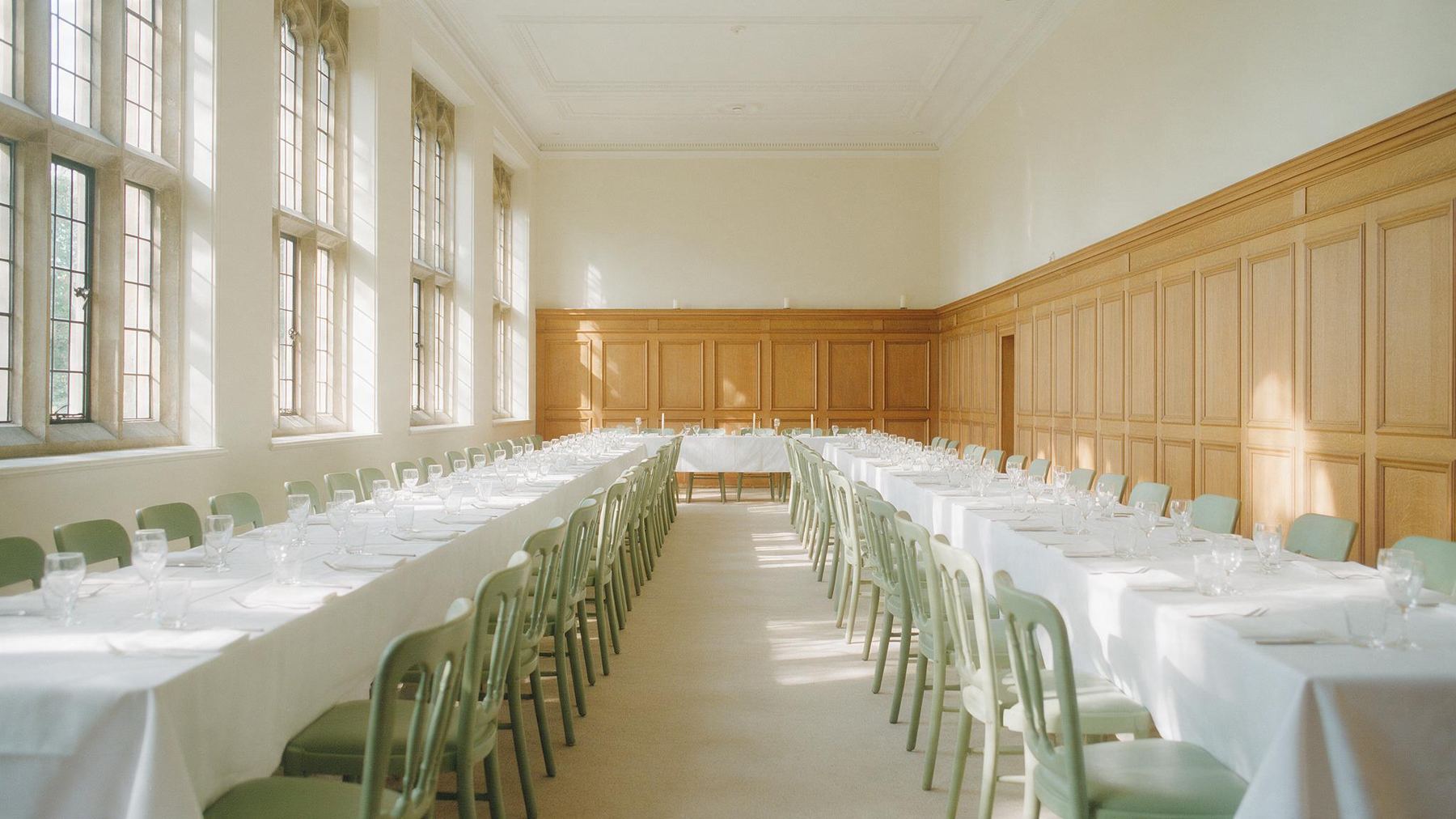
- Collingwood College, Durham University
- Presidency
- Dr Adrian Curtis
Programme
Collingwood College, Durham University
South Road, Durham DH1 3LT (see here for a googlemaps link).
4-6 January 2016
Under the presidency of Dr Adrian Curtis
Printable Version of the SOTS Programme.
Booking form for the Summer Meeting (pdf / doc)
The venue for all sessions is Collingwood College, Durham (please see here for a description, and here for map of Durham).
Publishers are invited to display books for sale during the Meeting.
Members who have had books published recently are also invited to display copies.
MONDAY 4 January
- [2.00 p.m. Committee Meeting]
- 4.30 p.m. Registration
- 6.00 p.m. Reception, sponsored by Sheffield Phoenix Press
- 6.45 p.m. Dinner
- 8.15 p.m. Presidential address: Adrian Curtis (Manchester), “From People and Book to Text in Context: Volumes That Speak Volumes”
TUESDAY 5 January
- 8.00 a.m. Breakfast
- 9.15 a.m. David Firth (Nottingham), “Creating Narrative Instability in Joshua 1-5”
- 10.00 a.m. Bernard Jackson (Manchester), “The Whodunit underlying the plot of the Book of Ruth”
- 10.45 a.m. Coffee
- 11.15 a.m. Heather McKay (Ormskirk), “Clothing, Adornment and Accoutrements in the Historical Books”
- 12.00 noon Nicolas Wyatt (Edinburgh), “The Rumpelstiltskin Factor: Explorations in the Arithmetic of Pantheons” [you can find a pdf of Dr Wyatt’s powerpoint here]
- 13.00 p.m. Lunch
- 3.00 p.m. Seminar “Research in progress”: PhD students and early career researchers present their work
- 4.00 p.m. Tea
- 4.30 p.m. Julie Woods (London), “Flaming Symbols: A Study of Fire as a Symbol of God’s Presence and Word in the Pentateuch and Jeremiah”
- 6.30 p.m. Dinner
- 8.15 p.m. Thomas Römer (Lausanne/Paris), “Yhwh, a god of the wilderness? The question of the origin of the Exodus tradition” [you can find a pdf of Prof. Römer’s powerpoint here]
WEDNESDAY 6 January
- 8.00 a.m. Breakfast
- 9.15 a.m. Maria Cioată (Manchester), “Moses Gaster and the Study of the Apocrypha and Pseudepigrapha”
- 10.00 a.m. Donn Morgan (Berkeley), “The Writings as Post-exilic Canonical Literature: Problems, Challenges, Significance”
- 10.45 a.m. Coffee
- 11.15 a.m. Margaret Barker (Borrowash), “The First Englishing of the LXX”
- 12.00 noon Business Meeting (Members only)
- 1.00 p.m. Lunch, followed by departure
Domestic Arrangements
The venue for the Meeting is Collingwood College, Durham University, South Road, Durham, DH1 3LT; the telephone number for the College is 0191 334 5000. Please refer to the enclosed map for information on how to get to the College. There is plenty of parking at the College but we would recommend public transport where possible.
The charges for hospitality are shown on the enclosed Booking Form. Members are requested to pay their accounts in full when returning the form but, if necessary, a non-returnable booking fee of £30 will be accepted and the balance will be payable on arrival at the Meeting. A discounted price is available to those whose bookings are received by Friday 13th November 2015 (please see the details on the form). There is a subsidized price for those on low incomes or from economically disadvantaged countries. All bookings must be received by Tuesday 8th December 2015; no bookings can be accepted after that date. Bookings can be made by email to sotshospitality@gmail.com with cheques to follow by post. Please note that in making a booking, members render themselves liable for payment of the full cost of that booking, a liability that will be waived only in the light of extenuating circumstances and only when the final conference accounts permit a refund. You may wish to consider taking out insurance on your booking (or check that your annual travel insurance is applicable) to cover the possibility of you having to cancel your booking. You are advised to make a copy of your completed Booking Form for your own records.
Members wishing to attend the Meeting should send the enclosed Booking Form to the Hospitality Secretary, Mr James Patrick, Mansfield College, Mansfield Road, Oxford OX1 3TF (sotshospitality@gmail.com) so as to arrive by 13 November 2015 (for the discount price) or at the latest by 8 December 2015.
Abstracts
Adrian Curtis (Manchester), “From People and Book to Text in Context: Volumes That Speak Volumes” [presidential paper]
In preparation for a contribution to the volume planned to mark the Society’s centenary, the paper surveyed the five volumes produced under the auspices of SOTS which sought to offer a broad overview of aspects of the study of the Hebrew Bible, namely The People and the Book (ed. A.S. Peake 1925), Record and Revelation (ed. H. Wheeler Robinson 1938), The Old Testament and Modern Study (ed. H.H. Rowley 1951), Tradition and Interpretation (ed. G.W. Anderson 1979), and Text in Context (ed. A.D.H. Mayes 2000). They cover the bulk of the 20th century, with three-quarters of a century between the dates of publication of the first and the last. Shifts in emphasis and in areas of interest were noted, both in terms of what topics were included and the approaches which were adopted. It was suggested that the volumes contain not only a wealth of scholarship, but ample evidence that the subject has not been static, has accepted changes of emphasis—perhaps sometimes rather slowly—and has not been inward looking insofar as it has attempted to take onboard insights from other disciplines. They also reflect the Society’s ongoing concern to make the fruits of scholarship more widely accessible and available beyond the academy. The volumes reveal changes in the Society as well as changes in scholarship. Trends noted include a shift away from the feeling of a necessity to include specific essays on relevance for Judaism and Christianity, and an acknowledgement that commitment to the study of the Old Testament is not confined to the confessional. The male/female ratio of contributors is now a matter of history and would probably not even have been noticed, let alone commented on, when lists were drawn up for the earlier volumes. The fact that it is now something of an embarrassment reflects a significant change!
David Firth (Nottingham), “Creating Narrative Instability in Joshua 1-5”
Although the poetics of narrative in the Old Testament have been widely studied in recent years, the book of Joshua has largely been marginalised, appearing only rarely in discussions of narrative. Reasons for this are unclear, but it means that issues in its interpretation remain unclear. As a result of this, conflicting readings of parts of the book have emerged. This paper noted three variant readings of Joshua 2 that in various ways contradict each other. But rather than arguing for one against the others or rejecting them all, it argued that each is a plausible reading of the text depending on the level at which it is read. This possibility emerges through the application of the concepts of anachrony and focalisation as developed by the narratologist Gerard Genette. Using these as a grid, it emerges that these chapters deliberately create an unstable narrative world that readers cannot fully resolve until later and to which they must return for subsequent reading after various external anachronies are introduced.
Bernard Jackson (Manchester), “The Whodunit underlying the plot of the Book of Ruth”
This paper examined literary dimensions of the Book of Ruth, corresponding to what in some forms of linguistics is termed the syntagmatic axis: the flow of the story in its sequence. It argued that taking the syntagmatic axis separately entails taking seriously what the text itself implies regarding the legal relationships involved, without imposing interpretations derived externally. It insisted that this also raises the question of audience and that the audience of the book was surely not one of biblical scholars; it was rather a popular audience to whom the author assumes that the legal practices (s)he describes would have been familiar. On the other hand, the overall plot is not something the audience is taken to know in advance. Rather, there are elements of ‘whodunit’, which keep the audience interested. Throughout, we have to ask: who knows what and when, and this question must be posed not only to the characters in the story, but also to its audience. The paper suggested that we are confronted at the outset by a major puzzle: what happened to the land of Elimelekh when the family left Bethlehem for Moab? Only later is this revealed, largely through analysis of the name of a character who appears on the scene only in the last act (ch.4). What is the relationship to this of the growing relationship between Ruth and Boaz in chapters 2-3? And how is the issue finally resolved (an issue involving a difficult textual problem in 4:5), and for whose benefit? Have Naomi and Boaz been in cahoots (behind the scenes) from the moment the women returned? The answers this paper offered may be found at greater length in a pre-publication version (still liable to change) of the author’s ‘Law and Narrative in the Book of Ruth: A Syntagmatic Reading’, available on both SSRN and www.academia.edu.
Heather McKay (Ormskirk), “Clothing, Adornment and Accoutrements in the Historical Books”
This paper introduced the members to Goffman’s ‘personal front’, which is composed of: facial expressions, body language, attitudinal positions and movements, clothing, cosmetics, hairstyles, adornments and the assumption—or not—of accoutrements. Hence, humans assume clothes that mark their gender, status and, often, a particular assumed role. People can also change their mood by a change of clothes; they can disguise their feelings, intentions—even themselves—and for a variety of reasons and purposes, ranging from benign to nefarious. This paper sought to show that biblical authors/editors often say more than is immediately apparent when they refer to clothing, adornments and accoutrements: first, because the role of these items often indicates more subtle features of the plot and of the characters, and secondly, because by repeatedly referring to these items they show where the deeper interests of those authors/editors lie. Those items that touch the skin of human beings, whether for hours on end, such as their clothes, or are briefly held in the hands—ornaments, tools or weapons—become extensions of that person, of their desires, aims and goals. Noticing the role/s played by them helps readers to notice the human characters in a more cognizant and understanding way. Such careful attention also helps readers to see something of the aims and desires of the writers. Although the stories are in fact merely stories that could be told in different ways—as may be witnessed in the Chronicler’s retelling of stories from the earlier Histories—the meaning for the readers will always lie in ‘the way they tell them’.
Nicolas Wyatt (Edinburgh), “The Rumpelstiltskin Factor: Explorations in the Arithmetic of Pantheons”
This paper addressed the very different enumerations of deities in ancient Near Eastern cultures. Examples were drawn from Ugarit, Mesopotamia, Hatti, Egypt and Israel-Judah. While pantheon-lists often appear to contain precise numbers of deities, the modern reader is quite often left with a sense of deliberate imprecision, the various computations, triads, tetrads, pentads, ogdoads, enneads (and even thirty-three in three of the Ugaritic lists), disguising rather than revealing the mystery of the godhead, and perhaps expressing unity in an image of plurality. Even the seventy of Deut 32:8 seems to be rather slippery. After a general survey of various ancient Near Eastern systems, the paper turned to the revelation narrative of Exodus 3. Analysis of this complex text suggested that far from revealing the name of the one true god, the narrative at best puts obstacles in the way of perceiving the reality of God, and at worst presents him as a heptad!
Julie Woods (London), “Flaming Symbols: A Study of Fire as a Symbol of God’s Presence and Word in the Pentateuch and Jeremiah”
This paper began by reminding members that fire is a primary symbol of the Divine presence in the Pentateuch, especially at Sinai / Horeb, notably, in the burning bush of Exod 3 and the theophany of Exod 19-20 and Deut 4-5. Indeed, fire seems a pertinent symbol to depict the LORD, more broadly, in both the Pentateuch and the Latter Prophets. Moreover, both fire and God’s presence engender the responses described by Rudolph Otto as mysterium tremendum et mysterium fascinans. The paper suggested that the Prophets are consistent with the Pentateuch in the way that they use fire to symbolise God’s presence and in the way humans react to that presence, as Isaiah’s and Ezekiel’s call narratives demonstrate. Also, as God’s presence and his word are sometimes indistinguishable in the Pentateuch, so are they in Jeremiah (see Jer 7; 26; 17:12-18). The paper observed that in Jeremiah, fire is used to symbolise God’s word, which is appropriate given that God’s word is a source of mysterium fascinans to Jeremiah, and both fire and the word maybe advantageous or destructive. The paper noted that God’s word and fire collide, combine and combust in Jer 36, but not in the way that Jehoiakim expects when he burns the scroll in order to put an end to God’s words. It is unsurprising that his quest fails since burning fire with fire only creates a better fire. Instead of being destroyed, the word is simply rewritten (with additions) as it had been at Sinai (Exod 34). Finally it was observed that while the king of Judah fails to destroy God’s words, the king of Babylon would succeed in fulfilling them and destroying Judah. Now, however, instead of simply ruining the city, as had been prophesied and as Jehoiakim had feared, the rhetoric of the surrounding chapters (chs 34, 37-39) declares that he would burn ‘this city’ with fire as Jehoiakim had burned the scroll with fire.
Thomas Römer (Lausanne/Paris), “Yhwh, a god of the wilderness? The question of the origin of the Exodus tradition”
This paper began by observing that the Hebrew Bible contains several texts that reflect a tradition according to which Yhwh was a god residing on a mountain three days journey away from the land of Egypt. This location fits nicely with another tradition that places the encounter between Israel and its god in a Midianite territory. To this one may add four poetic texts that locate Yhwh in Seir or Teman. The motif of the Hebrews who want to sacrifice to Yhwh in the wilderness, which occurs at several places in the book of Exodus reflects a different tradition from the ‘official’ Exodus tradition which is about a definitive departure of the Hebrews from Egypt. The paper suggests that although most of these texts underwent later reworking they probably conserve an historical memory that can be supported by extra-biblical evidence: Yhwh was, in the beginning, a ‘Southern god’ residing in the wilderness.
Maria Cioată (Manchester), “Moses Gaster and the Study of the Apocrypha and Pseudepigrapha”
This paper noted that, as a nineteenth century scholar, Moses Gaster (1856–1939) did not separate what are now regarded as two distinct fields. Much of his work was dedicated to apocrypha and pseudepigrapha, folklore, magic and mysticism. Using examples from his work, this paper illustrates the different ways in which Gaster used the terminology and how he perceived this literature. Throughout his publications, Gaster’s use of terminology connects apocrypha, pseudepigrapha, saint’s lives, medieval rewritten bibles, folklore as well as magical and mystical literature. Regarding Gaster’s contribution to the modern study of the apocrypha and pseudepigrapha, this paper concludes that his views on the antiquity of certain compositions and manuscripts now known to be medieval may be safely discarded. The same is true for his emphasis on heretics (particularly Bogomils) as responsible for the transmission of apocrypha. Nevertheless, it also concludes that Gaster made an important contribution by bringing to light many Jewish and Christian medieval compositions. In addition to his work on actual manuscripts, Gaster’s contribution may now be appreciated for its interest in and understanding of the history of reception of the ancient texts.
Donn Morgan (Berkeley), “The Writings as Post-exilic Canonical Literature: Problems, Challenges, Significance”
This paper began by tracing a history of scholarship devoted to the Writings as canon and scripture over the past fifty years, beginning with the work of T. Henshaw The Writings (1962) and ending with Steinberg and Stone (eds.) The Shape of the Writings (2015) and the forthcoming Oxford University Press Handbook on the Writings (2018). It noted the centrality during this period of Qumran literature, which has resulted in new assessments of canon formation and history and the methods used to examine them. It also observed that the climate and the context for the study of scripture and canon has changed, with new emphases on holistic reading and on things post-modern, post-colonial, et al. emerging alongside a growing interest in the reception history of the Bible. The paper proceeded to offer views on: (1) the dating of the final formation of this canonical division and its consequences; (2) the significance of the order/sequence of the books; (3) the ongoing pertinence of the post-exilic context for the Writings; and (4) the significance of ‘new’ ways of reading and interpreting the Writings (canonical, reception history, etc.). It concluded by affirming that biblical scholarship over the past fifty years bears witness to the specialness of the Writings as canon and scripture and it called members of SOTS to become apologists to wider communities of faith where the import of this literature is not yet recognized.
Margaret Barker (Borrowash), “The First Englishing of the LXX”
This paper introduced the work of Charles Thomson, the first person to translate the LXX into English, a work published in 1808. His northern Irish family went to settle in America, but he was left an orphan. He was taught Greek by a local clergyman, and this remained a life-long interest, even while his political career flourished in the then-colonies. Eventually becoming the first Secretary of the Congress, he then spent his retirement working on the translation. He made some interesting choices: he chose ‘cotton’ for Greek words usually translated ‘fine linen’. He also marked the margins of parts of the prophets, suggesting that he imagined them as a script for a Greek-style drama: two actors and a chorus. The actors were the Lord and the prophet, and the chorus was the people of Jerusalem. It was considered whether, if the practice of the Jerusalem temple had been a factor in the development of Greek drama, some priests might have worn masks as they did in Egyptian temples, or indeed whether the four living creatures by the throne in Ezekiel’s vision were inspired by the masked priests he knew in the temple.