Winter meeting · Residential
Winter Meeting 1998
- Dates
- 5–7 January 1998
- Venue
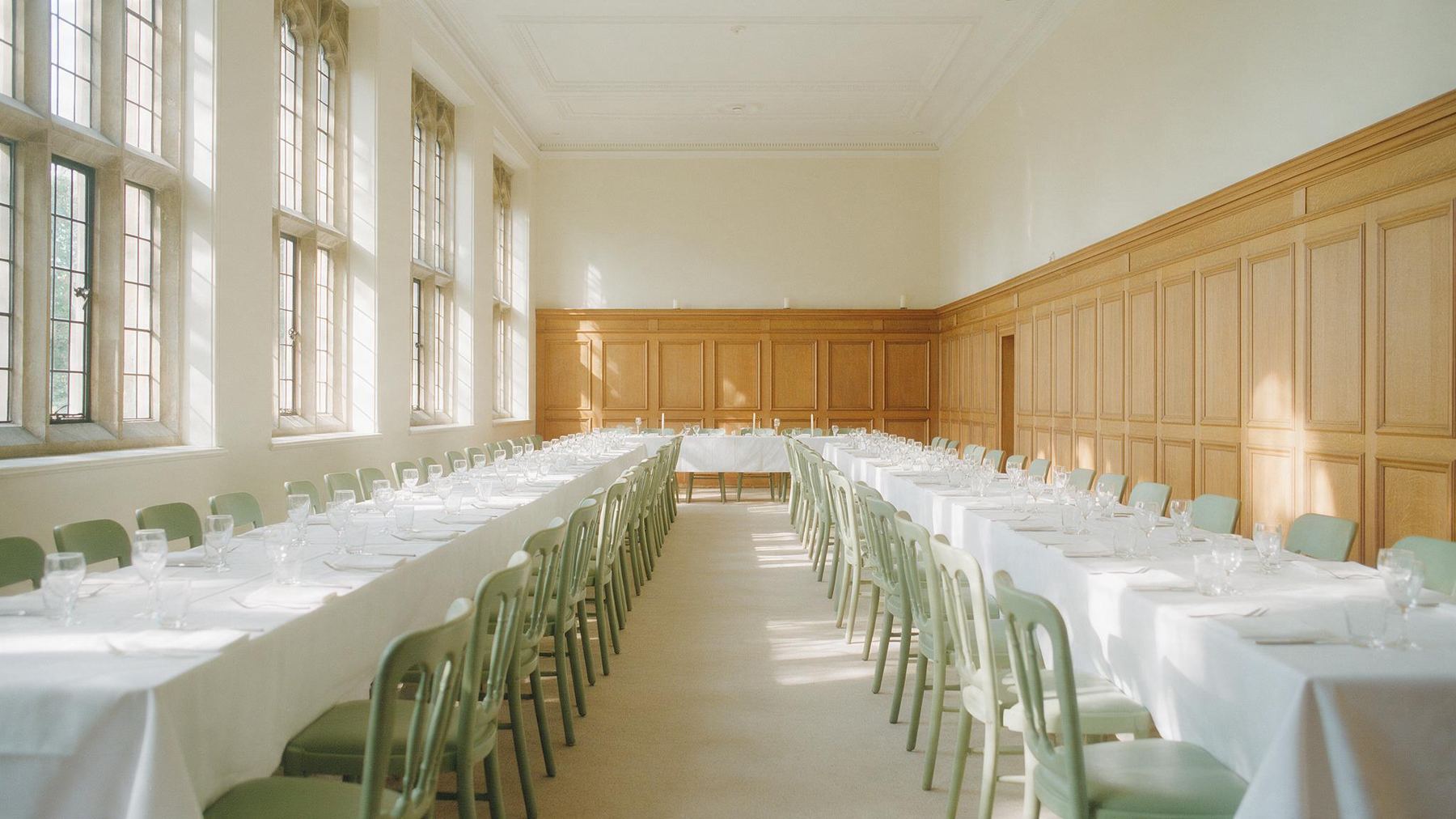
- St Catharine’s College, Cambridge
Papers
At St Catharine’s College, Cambridge from Monday to Wednesday, 5-7 January 1998.
Special theme: Temple and Worship
Mrs Margaret Barker (Borrowash): The Veil of the Temple (Presidential Paper)
Dr Walter Houston (Manchester): Tragedy in the Courts of the Lord: The death of Nadab and Abihu in Literary Perspective (Short Paper)
Dr John Elwolde (Sheffield): Distinguishing linguistic from exegetical: The case of Numbers in MT and DSS (Short Paper)
Dr Robert Hayward (Durham): The Chant of the Seraphim and the Service of the Second Temple
Mr H. J. Mayled-Porter (Chief Examiner for Religious Studies, O.C.E.A.C.): The future of the Old Testament in the sixth form
Dr Robert Murray (London): Images of the Temple
Dr William Horbury (Cambridge): The Biblical Background of the Eighteen Benedictions
Abstracts
Presidential Address: Mrs M. Barker (Borrowash). ‘The Veil of the Temple’:
The veil of the temple separated the xhpb from the jlhi, and is the key to understanding the temple symbolism in apocalyptic texts. It separated eternity from the visible, material world. When the high priest entered the xhpb he entered eternity and was able to know all history, past and future. The correspondence between creation and the pattern of the tabernacle/temple shows that the xhpb represented Day One. Those who entered learned the secrets of creation. This accounts for the characteristic subject matter of the apocalypses: the throne, overviews of history and the secrets of the creation. All this was high priestly knowledge originating in the first temple. Consideration of style and vocabulary shows that these ideas underlie Isaiah 40 and also Plato’s Timaeus. The interpretations found in Philo can no longer be considered Platonising distortions but rather reflect the original understanding of the temple.
Dr Walter Houston (Manchester): ‘Tragedy in the Courts of the Lord: the Death of Nadab and Abihu in Literary Perspective’:
This argued that Aaron should be seen as the tragic hero of the story in Leviticus 10. He is affected not merely by the death of his sons, but also by its shameful circumstances, and the disgrace is emphasized by Moses’ conduct. He should be seen, however, within the Pentateuchal narrative, as being ultimately to blame for his own tragedy, owing to his countenancing idolatry among the people. The paper concluded by pointing out that the theme of the father being disgraced by his sons is very widespread in the narrative of the Hebrew Bible, and suggesting a possible motivation in the socio-cultural milieu for the popularity of such a theme.
Dr John Elwolde (Sheffield): ‘Distinguishing the Linguistic and the Exegetical: The Case of Numbers in the Bible and the Damascus Document’:
This paper briefly examined Num. 21:18a=CD 6:3-4; Num. 30:17=CD 7:8-9/19:5; Num. 16:2=CD 2:11; Num. 18:2=CD 4:2-4; Gen. 49:10=4Q252 5:2; Ezek. 44:15=CD 3:21-4:1, arguing that divergences from the biblical text at Qumran are often better understood as the result of purely linguistic processes rather than of exegetically-motivated change. Hebrew forms discussed include //gv (‘lawgiver’, not ‘staff’), `hLd (‘ruler’, not ‘sceptre’); µdhyhx/(‘ones called by name’), µ[ i,jn (join with’, of proselytes, not Levites).
Dr Robert Hayward (Durham): ‘The Chant of the Seraphim and the Service of the Second Temple’:
Despite repeated claims that the words of the seraphim reported in Isaiah’s vision (Isa. 6:1-4) were used liturgically in the Temple, no direct evidence of such use survives. The paper examined options of this chant current in Second Temple times as expressed in surviving forms of the Hebrew text and in exegesis preserved in the ancient versions. From the point of view of the Second Temple exegete, the MT could be interpreted as either confining the seraphim’s words to heaven alone, or as suggesting the propriety of their being sung on earth; the 1QIsa MS may also indicate speculation about the manner in which the chant was uttered, a concern also betrayed by the LXX rendering. The latter sought to emphasise the earthly temple as the site of Isaiah’s vision, while retaining its heavenly dimension: this is in tune with LXX of Exod. 25:8-9, where the earthly Temple is to be constructed according to a heavenly paradeigma so that God may be seen among Israel. The Book of Jubilees insists that Israel shares privileges with the highest angels, including angels of sanctification who chant God’s praises. Targum of Isa. 6:1-4 relates the words of the seraphim to proclamation of God’s holiness in heaven and on earth; and coincidence of its exegesis in points of fine detail with LXX suggests also its antiquity. All these sources lead us to believe that the chant was appropriate for liturgical use in the Temple. Their failure to state that it was so used, however, is striking, and may be largely explained by two divergent contemporary appraisals of the Second Temple. Some writings view it as lacking in sanctity (e.g. 1 Enoch 89:73ff., Tobit 14:5; Test. Moses 4:8; b.Yoma 21b), and would be unlikely to refer to the Sanctus if it had been used liturgically. Other writings, accepting the Temple’s sanctity, may have wished to avoid vulgar discussion of holy chants altogether.
Dr Robert Murray (London): ‘Images of the Temple’:
This illustrated talk was given with free commentary. Attempts to picture the Temple and its furniture are extant only from after the destruction of Herod’s temple; probably the whole area was empty till the Muslim structures arose. Pictorial efforts have focused variously on the Mosaic Tent as described in Exodus, on Solomon’s Temple as in Kings and Chronicles, on Ezekiel’s vision or on Herod’s Temple as described by Philo and Josephus; sometimes elements of Tent and Temple are fused, and eventually the latter could be pictured in terms of the Dome of the Rock or of church architecture. (1) The earliest extant pictures are frescoes in the Dura synagogue (before 250 CE: tent, ark, idealized temple). (2) More systematic are the illustrations to Cosmas’ Christian Topography (c. 548), in the Sinai MS (11th century), representing Cosmas’ cosmic theories and how the Tent corresponded to the structure of the cosmos. (3) Mosaic pavements of Palestinian synagogues (4th-6th centuries) show a stable tradition of representing the Tent and its furniture, with relation to cosmic order, especially in Beth Alpha. (4) Abundant Jewish MS illustrations (13th-15th centuries) mainly picture the sacred furniture, often set in a framed pattern which may have already served the Cosmas artist. (5) Reasoned reconstructions based on dimensions in the Bible and Josephus began in the 16th Century and became increasingly grandiose, ingenious and incredible. (6) Finally some Christian images were reviewed, mainly variations dependent on temple traditions (Rev. 11 and 21-22) and treatments of the Temple as type of the Church. In Constantinople a claim to surpass the splendour of the Temple inspired the architects first of St Polyeuktos (long destroyed but for fragments) and then of Hagia Sophia, as is proved by ground dimensions, decorative motifs and texts.
Dr William Horbury (Cambridge): ‘The Biblical Background of the Eighteen Benedictions’:
The central petitionary section of the Eighteen Benedictions (Benedictions 4-14) is a mosaic of biblical quotations and allusions; but against what broader biblical background can it best be understood? In the period of the Mishnah the prayer was clearly fluid, as would also have been true of contemporary Christian prayer; but thematically and structurally it was also clearly close to the forms later attested in Jewish prayer texts. Probably it took shape in the Second-Temple period, as has long been thought: the petitions of the series 10-14 find correspondence in 2 Macc. 1:25-30 and, more fully, in Ecclus. 36:1-17; themes of the series 4-7 occur in the Qumran Words of the Luminaries: and the expansion of Ecclus. 51 attested in the Cairo Genizah Hebrew fragments has points of contact with 7, 10 and 14. The petitionary section can be envisaged as two clusters of petitions connected with redemption but also appropriate to recurrent needs (as with the prayers for forgiveness and a fruitful land); it is significant that 7 and 10 are particularly close to the mottoes ‘liberty’ and ‘redemption’ found on the coinage of the Judaean revolts against Rome. The importance of prophetic background material (including Isa.1:26-8, Ezek. 36:24-7) is noted in the Talmud (Meg. 17b) by later commentators; but it seems that the underlying theme is one widely attested in the Second-Temple period, recollection of the exodus and hope for a new exodus. Thus 7 ‘Look upon our afflictions’ probably recalls not only Ps.119:153-4, but also Exod.3:7 ‘I have surely seen’.
An informal talk was also given by Mr H. J. Mayled-Porter (Chief Examiner for Religious Studies, O.C.E.A.C.) on the topic of ‘The future of the Old Testament in the sixth form’ in which he outlined changes to the A-level syllabus and how they affected the teaching and examining of the Old Testament. He called for members to consider writing textbooks for A-level courses.